
When you search for the Nestle org chart, you are almost never looking for a decorative diagram. You are trying to understand who actually makes decisions inside one of the largest and most complex organizations on the planet, whether for a sales approach, a partnership conversation, a supplier pitch, or a job application. The structure is real, consequential, and navigable, if you know how to read it.
This guide covers how Nestle is organized, who leads its major divisions, how the matrix works in practice, and, crucially, how to identify and reach the right contacts if you are approaching Nestle as a B2B seller or partner.
What Kind of Organization Nestle Is
Nestle is a Swiss multinational food and beverage corporation, headquartered in Vevey, Switzerland. It is one of the largest companies in the world by revenue, operating in nearly every country, with a portfolio that spans infant nutrition, bottled water, coffee, chocolate, pet care, frozen food, medical nutrition, and dozens of other categories.
The sheer scale creates an organizational challenge: how do you run a business that sells Nespresso capsules, Purina dog food, Gerber baby formula, and KitKat chocolate bars across 190 countries with any coherent strategic direction? The answer Nestle has settled on is a matrix structure, which is both its greatest operational strength and the primary reason the org chart is so hard to read at first glance.
The Nestle Matrix: How It Works
A matrix organization combines two or more reporting dimensions simultaneously. At Nestle, this means a manager might report both to a geographic zone president and to a global category head. A regional marketing director in Europe is accountable both to the European zone and to the global category for the product they manage.
The three axes of the Nestle matrix are:
Geographic zones. Nestle organizes its global operations into major geographic zones: the Americas (AMS), Europe (EUR), and Asia, Oceania, and Africa (AOA). Within Europe, there are further country-level structures with national managers and local teams. Each zone has significant autonomy over market execution, local partnerships, and adapting global strategy to regional conditions.
Global business units and product categories. Running across all zones, Nestle maintains global business units (GBUs) and category structures. These include: Purina Petcare, Nestle Nutrition (infant formula), Nespresso, Nestle Waters, and broader categories like confectionery, dairy, and frozen food. Each GBU or category has global leadership responsible for innovation, brand strategy, and profitability across all geographies.
Corporate functions. Layered across both the geographic and category dimensions are central functions: Finance, Human Resources, Supply Chain, Legal, R&D, IT, Communications, and Sustainability. These functions set global policies, standards, and systems that all zones and categories must follow.
The practical implication for anyone approaching Nestle from outside: the decision for any significant project or purchase is almost never made by one person. It typically involves both a zone-level stakeholder and a category or functional stakeholder, and often a procurement layer on top of that. Understanding the matrix is not optional context, it is the starting point for any serious prospecting strategy.
The Board of Directors and Executive Leadership
Nestle’s governance follows the standard structure of a Swiss public company: a Board of Directors that oversees strategy and compliance, and an Executive Board that runs day-to-day operations.
The Board of Directors is chaired by Pablo Isla, who took on the chairmanship in 2026. The board includes independent directors with backgrounds in finance, consumer goods, and technology. Full board composition is published annually in the Nestle Annual Report, which is available on the Nestle corporate website and is the most reliable source for current names and roles.
The Executive Board, which is the operational leadership layer, is headed by Laurent Freixe, who became CEO of Nestle S.A. in September 2024. Freixe has deep internal experience, having previously led the Americas and Latin America zones before taking the chief executive role. The Executive Board typically includes the heads of the major zones, the CFO, and the chiefs of key functions such as human resources, supply chain, and technology.
For anyone doing B2B research on Nestle, the Executive Board composition published in the Annual Report is the most authoritative source for current leadership names. This is important because names and roles change: relying on outdated LinkedIn data or press from 18 months ago for a major enterprise account is a significant research risk.
Zone-Level Organization: The Americas, Europe, and AOA
Below the Executive Board, zone presidents lead the major geographic divisions. These are substantial roles with real P&L responsibility: the European zone alone represents tens of billions in revenue.
Zone presidents oversee: - Country market heads and regional presidents within their zone - Local commercial execution and market adaptation - Zone-level supply chain and manufacturing - Regional partnerships and distributor relationships
For a B2B seller, zone-level contacts are often the most actionable entry point for regional deals. A contract that covers France, Germany, Italy, and the Nordics is likely to be negotiated or at least influenced at the European zone level before any local market execution happens. Knowing who leads the zone, and which functional directors report into the zone, determines who you actually need to get in front of.
Product Categories and Global Business Units
In parallel with the geographic structure, Nestle’s product categories each have dedicated global leadership teams. The major GBUs and category groups include:
Purina Petcare is one of Nestle’s largest and fastest-growing business units, with dedicated global leadership, innovation pipelines, and commercial teams. If you are selling to Purina, you are effectively selling to a business unit that operates with significant autonomy from the broader Nestle structure.
Nestle Nutrition covers infant formula and related products under brands including Gerber and NAN. This category operates under significant regulatory scrutiny, which means its procurement and supplier management processes are more structured and formal than other categories.
Nespresso operates as a near-standalone business within Nestle, with its own retail network, direct-to-consumer model, and leadership team. Approaching Nespresso through the broader Nestle org chart structure is often less effective than engaging with Nespresso directly.
Nestle Waters and Nestle Beverages (including instant coffee outside Nespresso) have their own dedicated teams, though the waters business has undergone significant restructuring in recent years.
Confectionery and Dairy are managed through category leadership that spans both GBU-level strategy and local zone execution.
The practical implication: if you are targeting Nestle for a solution relevant to a specific category, your outreach should ideally reach both the category’s global procurement or supply chain contact and the regional zone contact who influences local buying decisions. Single-threading a large Nestle opportunity into one contact is almost always a mistake.
Key Functions to Target for B2B Selling
Depending on what you sell, the decision-making contacts at Nestle fall into different functional areas. Here is a practical map:
Procurement and Strategic Sourcing: For any supplier relationship, ingredients, packaging, technology, professional services, the procurement function is the formal gatekeeper. Nestle has a large global procurement organization with both category-specific buyers and regional buyers. Getting to procurement early is essential, but be aware that the business stakeholder (marketing, R&D, supply chain) often has significant influence on supplier selection before procurement becomes involved.
Supply Chain and Operations: For logistics, warehousing, manufacturing technology, or any operational service, supply chain leaders at the zone and GBU level are the primary targets. Nestle’s supply chain is one of the most complex in the world: any solution that can reduce cost or improve efficiency has a receptive audience.
Human Resources: For HR technology, training, workforce management, or any people-related solution, HR contacts at both the global and zone level are relevant. Nestle employs over 250,000 people globally, making it a significant target for enterprise HR technology.
Marketing and Digital: For marketing technology, research, data, creative, or media, the marketing function at both global category and zone level is the right entry point. Digital transformation has been a significant area of investment for Nestle, and there is active interest in data and technology solutions that improve marketing effectiveness.
R&D and Innovation: For ingredient suppliers, food technology companies, or research partnerships, the R&D function (centered at the Nestle Research headquarters in Lausanne, Switzerland) is the primary contact point.
How to Find the Right Contacts Inside Nestle
The Nestle Annual Report is the starting point for senior leadership. Published each spring, it lists the Executive Board and Board of Directors with current names and roles. This is the most reliable source for tier-one contacts.
LinkedIn is the most practical tool for finding contacts below the Executive Board level. Nestle has a large and relatively active employee presence on LinkedIn. Searching for “Nestle” plus a function (procurement, supply chain, marketing) plus a geography produces a manageable list of current employees with verifiable titles.
The Nestle corporate website publishes governance documents, press releases, and leadership announcements that can be used to verify titles and organizational changes. Major zone-level leadership changes are typically announced through press releases.
The challenge with a company this size: contacts are numerous but verification is difficult. People move between roles frequently in a large matrix organization, titles do not always reflect actual decision-making authority, and finding the right level (not too senior, not too junior) for a first outreach requires judgment.
Multi-Threading a Large Account Like Nestle
Single-threading large enterprise accounts is one of the most common and costly mistakes in B2B sales. If your only contact at Nestle leaves, is restructured out, or simply loses internal influence, you lose all the ground you gained. For an account as complex as Nestle, three to five active contacts across different functions and levels is the minimum for a serious enterprise opportunity.
The multi-threading strategy for Nestle should include: - A senior business sponsor at the GBU or zone level who understands the strategic value of what you offer - A procurement contact who manages the formal supplier evaluation process - A functional champion (the person in supply chain, HR, IT, or marketing who actually uses or benefits from your solution) who can advocate internally - A local market contact if the deal involves regional execution
Building this network from scratch is time-consuming. The contacts need to be verified as current (Nestle’s size means significant turnover and role changes), and outreach needs to be coordinated so that different contacts at the same company are not receiving contradictory messages from your team.
How Zeliq Helps You Navigate Large Enterprise Accounts Like Nestle
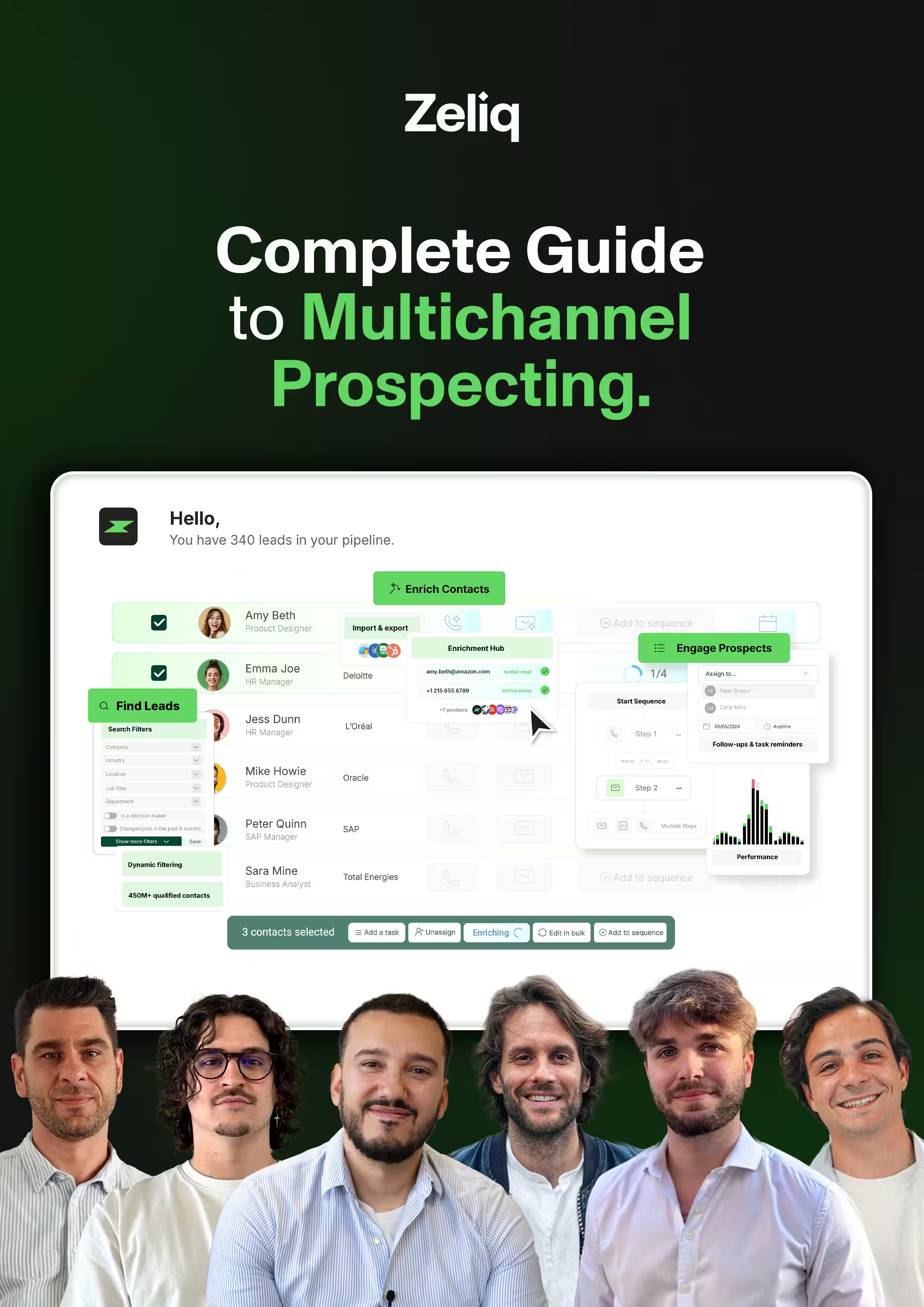
The contact discovery and verification challenge at an account like Nestle is exactly the problem Zeliq is built to solve. With a database of over 450 million contacts, Zeliq’s B2B contact search lets you filter by company, function, seniority, and geography to build a targeted list of Nestle contacts across the dimensions that matter for your specific deal.
The data enrichment layer then verifies emails and phone numbers using a waterfall approach across multiple providers, which significantly reduces the bounce rate problem that comes with large-enterprise prospecting. A 5% bounce rate is acceptable on a small list; on a 200-contact Nestle target list, it is a meaningful operational problem.
For managing the outreach itself, multichannel sequencing in Zeliq lets you coordinate LinkedIn, email, and phone touches across multiple contacts at the same account without losing track of who has heard what. This is particularly important at a company like Nestle where contacts within the same organization can and do talk to each other about inbound commercial approaches.
The Zeliq browser extension also works directly on LinkedIn, which means you can build your Nestle contact list from LinkedIn search results, enrich each profile with verified contact data, and add them to a sequence, all without leaving the browser tab. For an account where you are building a 20-contact multi-threading map, that workflow efficiency adds up quickly.
Understanding the Nestle org chart is half the battle. The other half is having the tools to turn that understanding into verified contacts, coordinated outreach, and a multi-threaded pipeline that does not collapse when one contact changes roles. That combination is what converts org chart research into actual pipeline.
Ready to find and reach the right contacts at large enterprise accounts? Zeliq gives you 450M+ verified profiles, waterfall enrichment, and multichannel sequencing to turn org chart research into real conversations.
Try Zeliq for freeEnter the future of lead gen