
Introduction Email: Templates and Method to Get a Reply
An introduction email is the first message you send to start a professional relationship with a prospect. To work, it needs to grab attention in seconds, signal a clear value, and make the reply effortless. Done well, it turns a cold contact into the start of a real conversation. Done poorly, it lands in spam or gets deleted before the first read.
Most B2B reps know the pain. You spend an hour on the subject line and the body, hit send, and get nothing back. Frustrating, but fixable. With the right structure and a few proven templates, an introduction email becomes a reliable channel for booking calls.
Introduction email: definition and goals by context
Cold introduction vs warm introduction. A cold introduction email reaches out to someone who has shown no prior signal of interest. A warm introduction builds on a real signal: a referral, a recent visit to your site, a comment on your LinkedIn post, or an event you both attended. Warm contacts are more open to engaging, and your message can lean on the existing context to earn the reply.
What the first email is actually trying to do. The real goal of a first email is not to sell. It is to take one step forward: get a reply, a quick exchange, or a redirect to the right person. The ask should be light. A heavy “set up a 30-minute demo” pitch in the first email asks too much from someone who has not yet decided whether you are worth a reply.
The structure that works (short, scannable in 20 seconds)
Subject line: clear, specific, not “salesy”. Pick a subject line that is precise but not transparently commercial. Examples that consistently work: “Quick question on your hiring”, “About your Q4 growth”, “Open to a 5-minute chat?”, “[Mutual contact] suggested I write”, “Your EU expansion”, “About your recent post”. The right subject states a specific topic. The wrong one screams “marketing email” before the recipient opens.
Hook: context plus reason in one sentence. Open with a single sentence that ties an observable detail to your reason for reaching out. Example: “I saw your job listing for a CMO and was wondering if you are already optimizing your inbound leads.” Skip the long “Allow me to introduce myself” intro.
Value: one concrete benefit, plus optional proof. Lead with one tangible benefit. Example: “Cut sourcing time by 30% in 30 days.” If you have a credible proof point, add one short reference: a similar customer, a quick case detail, or a measurable outcome. Keep it sober, no inflated claims.
CTA: one simple ask (yes/no or two slots). Make the reply trivial. A binary or near-binary ask works best: “Tuesday at 10 AM or Thursday at 3 PM for a quick call?” Two clean choices outperform an open-ended “let me know your availability” every time.
Signature: trustworthy and complete. Keep the signature simple and credible: name, title, company, phone, and website. Skip social icons, banners, and animated logos in a first email. Sober reads as serious.
Personalize without spending 30 minutes: the 5 levels
Level 1: first name + company (the floor). “Hi [First name], at [Company]”. Costs you 30 seconds, lifts engagement off the floor. This should be your minimum.
Level 2: role + a typical pain for that role. Add the recipient’s role and a known issue tied to it. Example: “As a Marketing Director at [Company], are you already optimizing your ad budgets?” Fast to do, one or two minutes per prospect with LinkedIn open.
Level 3: a fresh signal (hire, news, post, tool, growth). Layer a recent trigger: “Following your LinkedIn post on 2026 growth”, “Your CTO hire caught my attention”. Two minutes per prospect with a quick LinkedIn or news check.
Level 4: a problem hypothesis plus a question. Form a credible problem hypothesis tied to their stage: “With your scale-up phase, are you handling qualified leads manually? Worth a quick chat?” This needs a few minutes of research per prospect, three to five at most.
Level 5: mini segment angles (2 to 3 variants). Split your list by company size, sector, or role and prepare two or three angle variants per segment. Example: “For SMBs like yours, here is how [segmented benefit].” This is how you scale without losing relevance.
Introduction email templates by situation
Template 1: cold introduction (no signal)
Subject: Quick question on your growth?
Hi [First name],
At [Company], you are working on [sector pain like “inbound lead conversion”]. We help similar SMBs lift conversions by 25% in 30 days.
Worth a 10-minute call? Tuesday at 10 AM or Thursday at 3 PM?
[Signature]
Consultative variant:
Subject: Idea for [typical pain]?
Hi [First name],
I have noticed many [role] like you running into [problem]. Quick question: are you already optimizing [process]? Happy to share one quick tip either way.
Open to a chat?
[Signature]
Template 2: introduction via referral or shared contact
Subject: [Mutual contact] suggested I reach out
Hi [First name],
[Mutual contact] suggested I reach out about [topic]. At [Company], we help with [specific benefit].
Worth a quick call? Yes or no?
[Signature]
Template 3: introduction after an event (trade show, conference, webinar)
Subject: Following [Event]
Hi [First name],
Great running into you at [event]. Our short conversation about [topic] stuck with me.
Up for a 10-minute deeper dive on Tuesday or Thursday?
[Signature]
Template 4: introduction after a LinkedIn exchange or comment
Subject: About your post on [topic]
Hi [First name],
Your LinkedIn comment on [theme] was on point. We helped [customer type] on the same challenge with [benefit].
Quick question: [open question]?
[Signature]
Template 5: introduction after a call or missed call
Subject: Following yesterday’s call
Hi [First name],
Quick recap: Your challenge: [problem] Our angle: [benefit] Next step: A 15-minute follow-up call
Tuesday at 10 AM or Thursday at 3 PM?
[Signature]
Template 6: redirect introduction (find the right contact)
Subject: Quick question: who owns [topic] at [Company]?
Hi [First name],
I am trying to reach the person who owns [topic] at [Company]. Is that you, or could you point me to the right contact?
Thanks in advance.
[Signature]
Asking for the meeting without scaring the prospect
Sell the meeting, not the solution. Focus on the immediate value of the call, not your product. Say “A 15-minute call to walk through your priorities” rather than “Show me your tech stack.” Keep the duration short (10 to 15 minutes) to lower the psychological barrier, and propose a simple agenda upfront.
Suggest specific slots vs send a calendar link. Specific slots like “Tuesday at 10 AM or Thursday at 3 PM” outperform a calendar link in cold or warm introductions. They feel personal and decisive. A calendar link makes more sense after a first exchange or with a hot lead.
Duration, format, participants. Spell out the meeting basics: “15-minute video call” or “quick phone call.” Mention participants if relevant: “with me, on the sales side.” Clarity removes objections and speeds up the reply.
Follow-up: simple cadence and reminder messages
Use a progressive cadence: a soft reminder at D+2, a value-add at D+5, and a clean break-up at D+10. The B2B sales cycle typically includes 8 to 12 touches spaced one to three days apart, so this cadence fits inside that window without feeling pushy.
Short follow-up (D+2):
Subject: Quick reminder
Hi [First name],
Did you have a moment to look at my last note? Open to a quick chat?
Best, [Signature]
Follow-up with a resource (D+5):
Subject: Resource for [pain]
Hi [First name],
Following my earlier note, here is a short guide on [topic] that helped [customer type]. Worth a chat? Tuesday or Thursday?
[Signature]
Clean break-up (D+10):
Subject: Last attempt
Hi [First name],
I am closing this thread for now. If [topic] becomes relevant later, my line is open.
All the best. [Signature]
Switch to multichannel if silent. If two emails go unanswered, move to multichannel. A LinkedIn message, a second email with a different angle, then a short call. Keep it to three or four touches across channels, spaced two to three days apart.
Common mistakes that tank your reply rate
Email too long or too “we-focused”. Long messages centered on “we” and “our company” get deleted in seconds. They ignore the recipient’s priorities. Lead with “you” and stay short.
Vague or too “marketing” subject line. A blurry subject line like “Innovative solutions” either lands in spam or gets ignored. Use short, specific subjects oriented around a benefit or a question.
No clear CTA, or too many options. A missing or buried call to action confuses the prospect. Pick one ask. A binary choice gets the reply.
Pointless attachments in the first email. PDFs and decks attached to the first email trigger spam filters and hurt deliverability. Save attachments for confirmed follow-ups.
Unprovable promises or pushy tone. Claims you cannot prove, or a pushy tone, kill trust. Stay factual and conversational.
Pre-send checklist
Targeting: right persona, right seniority. Confirm the recipient matches your ICP: sector, company size, role. Wrong targeting kills open and reply rates.
Data: valid email, correct first name and company. Verify the work email is named (not a generic alias), the first name is spelled correctly, and the company name is exact. Clean data prevents bounces and signals “personal”, not “blast.”
Form: 80 to 120 words, short sentences, breathing room. Keep the message between 80 and 120 words. Sentences of 10 to 15 words. Frequent line breaks. Skip images and limit links to ensure mobile readability and clean deliverability.
Coherence: one goal, one CTA, no jargon. One clear goal, one binary CTA, plain language. Re-read for flow and typos before sending.
Scale your introduction emails with Zeliq
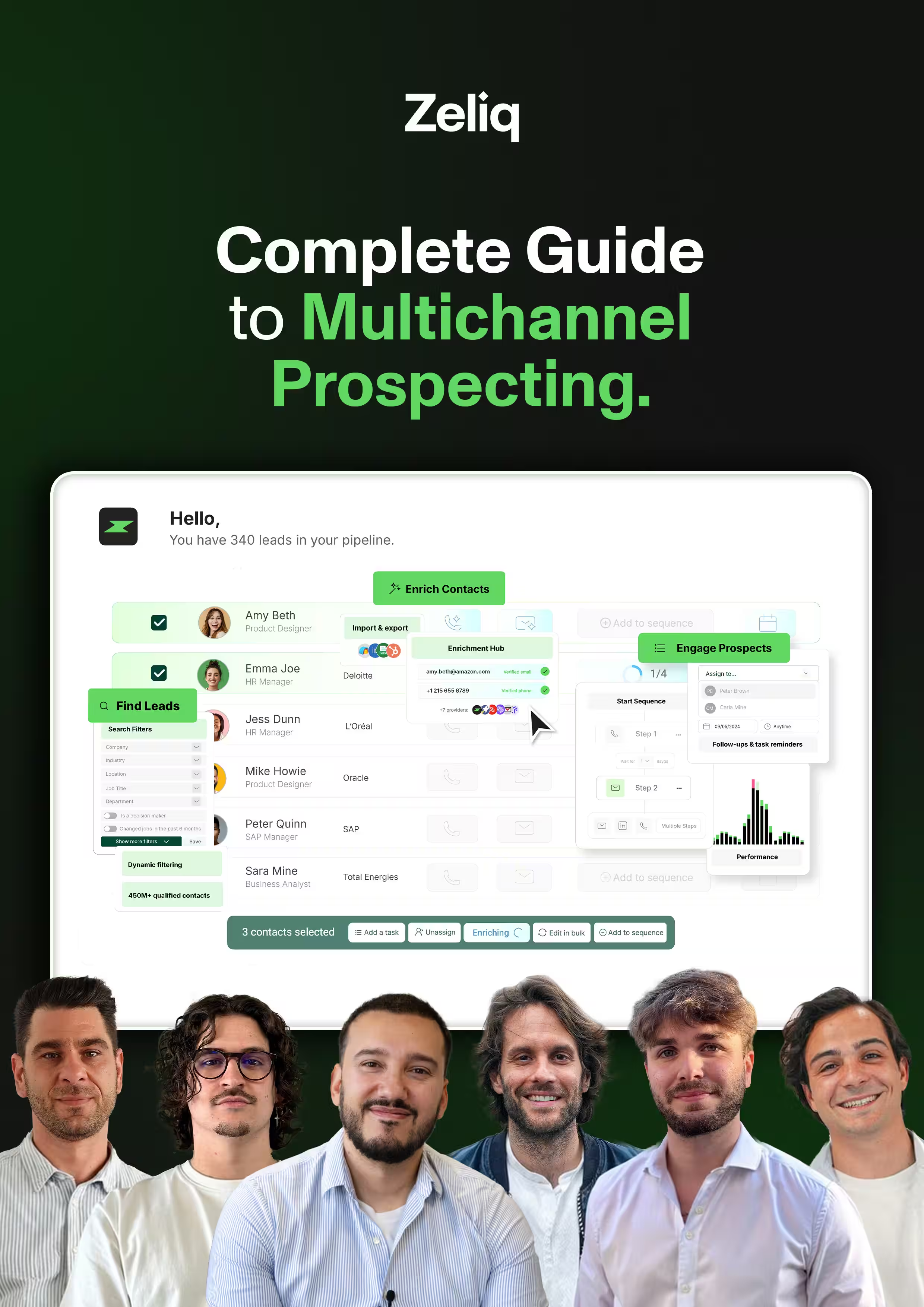
Build lists by ICP and signals. With Zeliq, build precise prospect lists by sector, company size, role, tech stack, and intent signals like active hiring or recent funding. Dynamic variables let you adapt the angle automatically.
Enrich contacts (emails and phones) to activate the right channel. Waterfall enrichment cross-references 40+ providers across a 450M+ contact database, returning verified data: about 80% on emails and 60% on direct phones. Automatic deduplication and deliverability checks keep your bounce rate low.
Run multichannel sequences (email + LinkedIn tasks + calls). Combine email, LinkedIn touches, and call tasks in one multichannel sequence. Smart scheduling (daily caps, randomized windows, auto-pause on reply) keeps the cadence human. Every interaction syncs to your CRM for a clean history.
Prioritize by engagement and keep the history clean. Lead scoring based on opens, clicks, and replies tells you which prospects to push first. Sequence-level analytics (positive replies, meetings booked per 1000 sends) let you double down on what works without losing the personal tone.
Ready to turn your first emails into booked meetings at scale? See how Zeliq helps you target, personalize, and sequence your outreach.
Book a demoEnter the future of lead gen